
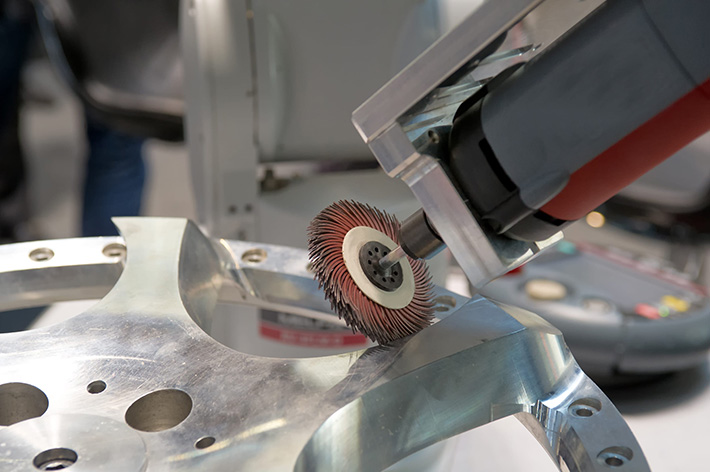
Modern laser cutting can produce clean and accurate parts, though cutting is often just one stage in the fabrication process. Parts may still require deburring and/or edge finishing prior to forming, welding, painting or assembly depending on the material and the requirements of the end component.
Metal fabrication services help ensure that parts meet the required standards for quality, appearance and performance.
Finishing operations such as deburring and edge finishing may seem to be less important than cutting and machining, yet they can make a significant difference in the quality and functionality of the finished component.
What causes burrs and rough edges?
A laser makes a narrow cut by focussing a very high level of heat onto the material, with an assist gas blowing the molten metal out of the cut. If the process is correctly set up the edge that results can be absolutely smooth.
Even so, with some materials and in some cutting conditions there can be a very small amount of material left along the lower edge (this is generally referred to as dross). Small burrs can also be left around certain features.
Material thickness has an effect on the way the cut behaves. Thicker plate will in general require more energy and present a different set of problems to thin sheet. The material itself will also have an effect on the rate at which heat travels through the workpiece and the ease with which the liquid metal will exit the cut.
As every job is different in its specifications the amount of finishing required can vary enormously.
Why Deburring Matters During Assembly
A tiny burr can be completely insignificant until you’ve got two parts that need to fit together exactly.
Raised material along an edge can interfere with the mating surfaces or stop the components from sitting flush against each other. A hole with a ragged edge can also be a problem when you’re inserting the hardware.
Removing the imperfections prior to assembly will ensure that the dimensions obtained during the cutting process are accurately reflected in the finished product.
Deburring can also make the parts safer to handle. Freshly cut sheet metal can have edges which are unpleasant or potentially dangerous for the people who are assembling the finished product. Deburring the correct surfaces will of course eliminate that issue in the later stages of manufacture.
Edge Quality Can Affect Welding
Parts that are going to be welded a lot will generally benefit from good edge preparation.
Welding is all about making a good joint. Excess residue or contamination along the cut edge can make that job a lot harder. Surface preparation gives the welder a cleaner area to work in and can go a long way to helping them achieve more consistent results.
This is particularly pertinent when you’ve got a project with very high quality requirements. The fabricator has to look at how each stage of the manufacture impacts the next rather than just looking at the laser cut in isolation.
Finishing Can Improve Coating Results
Lots of the fabricated components end up with a coat of paint, powder coat or some other finish.
Sharp edges can be a problem as the coating may not build up to the same thickness at a sharp corner as it will on a flat surface. A little edge smoothing can be very useful in preparing the part for the finishing operation.
Surface residue can also have an effect on coating adhesion. The required prep will of course vary according to the metal and the coating that’s going to be applied.
When it comes to cosmetic appearance edge finishing becomes even more important. Getting rid of those small imperfections can give you a much more consistent appearance prior to the final finishing.
Not Every Part Requires the Same Finish
Specifying an unnecessary finish will add to the production time and project cost. On the other hand, omitting a vital finish can lead to problems down the track.
The correct approach is going to be very much dependent on the purpose of the section.
A hidden structural component may have quite different edge requirements to an exposed enclosure panel. Parts that are going to be welded may have very different edge requirements to parts that are just going into a mechanical assembly.
Customers can assist their fabricator by identifying the important surfaces and telling them how the part is going to be used. The drawings should also be clear on any special edge requirements.
This enables the fab team to work out what level of post cut processing is appropriate for the project.
Complete Metal Fabrication Starts with Proper Planning
Laser cutting provides a very accurate starting point for modern metal fabrication, but successful manufacture is all about going beyond the first cut. The condition of the cut edge will have an effect on how easily the part moves through the subsequent operations and how well the final assembly performs.
Prototech Laser is a full-service metal fabricator with the capability to laser cut, form, machine, weld and assemble.
When planning your next project, working with an experienced fabrication team can help ensure that cutting and downstream processes are considered together from the beginning.
Connect with Prototech Laser online or call to discuss your requirements and find out how their manufacturing capabilities can help with your next production run.