
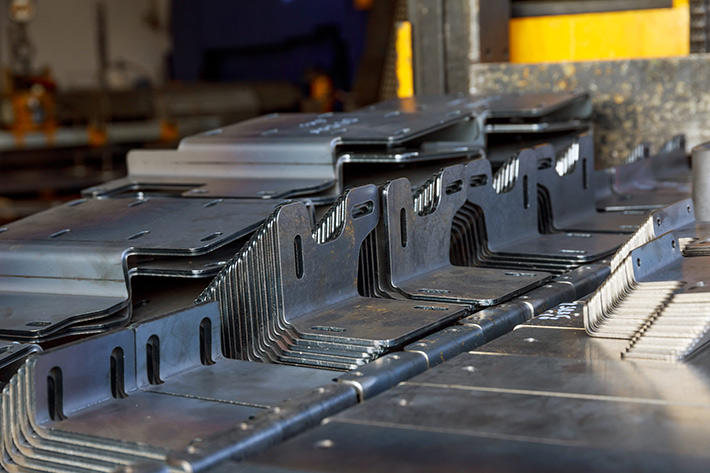
Laser cutting can do more than create the outside shape of a part. It can also add small locating features that make the next stage of fabrication easier.
Tabs and slots are a good example. A tab on one piece fits into a matching slot on another, giving the assembly a built-in reference point before welding or fastening begins. The idea is simple, but the effect can be significant. Parts that would normally need careful measuring and repeated adjustment can come together with less guesswork.
For customers ordering fabricated metal assemblies, tab-and-slot design can help reduce fit-up time;
as well as improve consistency and make production runs easier to control.
Small Features with a Practical Job
A metal assembly often depends on parts meeting at the right angle. A bracket may need to sit square against a plate. A cover may need to align with a frame. A support may have to stay in place long enough to be tacked without drifting.
Without locating features, the fabricator has to rely more heavily on layout marks, clamps, and manual positioning. That can work well for simple one-off parts. It becomes harder when the same assembly has to be repeated across a larger run.
Tabs and slots give the parts a more natural way to find their position. The tab starts the alignment. The slot helps hold the relationship between pieces. The fabricator still controls the setup, but the design gives the work a better starting point.
Why Fit-Up Matters Before Welding
Welding can only work with the fit-up it is given. If the parts are slightly out of position before the first tack, the weld may lock that error into the assembly.
Poor fit-up can also create gaps that require more heat to close. More heat can increase distortion, especially on thinner material or longer weld joints. A part that was laser-cut accurately can still end up difficult to assemble if the pieces are not held in the right relationship during welding.
Good tab-and-slot design helps reduce that risk. The parts are easier to place, and the welder can spend more time controlling the weld instead of fighting the setup.
When Tabs and Slots Make Sense
Tabs and slots are especially useful for brackets, frames, panels, covers, guards, and repeatable welded assemblies. They can also help when a part has a location that matters for later installation.
For example, a small internal bracket may need to sit in the same place on every unit. A tabbed design can help position it before welding. A formed panel may need a support attached at a fixed distance from an edge. A slot can give the operator a clear locating point without measuring from scratch each time.
These features can be useful in prototypes too. If the first version of a part will likely lead to a production run, designing fit-up into the part early can save time later.
The Design Still Needs Room to Work
Tabs and slots should help the shop, not create a new problem.
If the fit is too tight, parts may be difficult to assemble after cutting because small changes in material or finish can affect how they slide together. If the fit is too loose, the locating feature may not hold position well enough to matter. The right clearance depends on material thickness, process requirements, and how the part will be joined.
The tab also needs to be placed where it will not interfere with the weld, hardware, or final appearance of the part. In some designs, the tab can remain hidden inside the assembly. In others, it may need to be removed, ground flush, or kept away from a visible surface.
A good design review can help decide which approach makes sense.
Avoid Letting the Feature Do Too Much
Tabs and slots are helpful, but they should not be expected to replace every fixture or inspection step. Larger assemblies may still need a dedicated weld fixture. Parts with tight tolerances may still require careful measurement before release.
The best use is usually practical support. Let the tab locate the part. Let the slot reduce setup time. Then let the fabricator confirm the critical dimensions before the assembly moves forward.
That balance keeps the design helpful without making it fragile or overly complicated.
Better Fit-Up Can Improve the Whole Job
When parts come together cleanly, the fabrication process tends to move more smoothly. Setup takes less time. Welds are easier to place. Assemblies are more consistent from one build to the next.
That can also help with quoting and scheduling. A part designed for easier fit-up is often simpler to repeat. The shop can spend less time correcting small alignment issues and more time keeping the job moving through production.
Customers may not notice the tab or slot in the finished part, especially if the feature is hidden. They do notice the results when assemblies fit properly and arrive ready for the next stage of work.
Plan Fit-Up Before the File Reaches the Laser
Tabs and slots work best when they are part of the design from the beginning. Adding them after a fit-up problem appears can still help, but it may require revising files and cutting a new sample.
Early coordination gives the fabrication team a chance to review material thickness, weld access, clearance, and critical features before the part is made. That conversation can prevent small shop-floor problems from becoming production delays.
Custom Laser Cutting and Metal Fabrication in Chesterfield, MI
Prototech Laser provides laser cutting, metal forming, welding, machining, and assembly support for customers that need accurate fabricated parts and repeatable results. Their Chesterfield team can help review part geometry, plan practical locating features, and make sure laser-cut components are designed to move smoothly from cutting into finished assembly.