
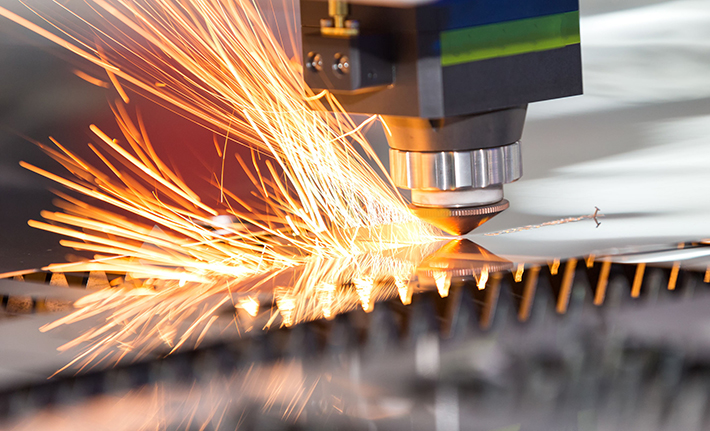
While laser cutting and wire EDM cutting are both fine choices for your precision cutting needs, there are some differences between the two. Depending on the type of material you are cutting, and the end use one process may be preferable to the other.
So, what are the differences between laser cutting and wire EDM cutting?
In short, each process performs best with different products and different applications. Laser cutting is for the hardest of materials while wire EDM has the capability of cutting thicker materials. Wire EDM can also work with tighter tolerances than laser cutting.
We will get into more detail on these differences below, beginning with how the two operations actually work.
The Process
The first distinction between laser cutting and wire EDM cutting is the process in which they operate. Laser cutting is a precision technique that uses a beam of light to burn and/or melt a path through the material being cut.
Essentially, a machine agitates electrons to a point in which they give off light in the form of photons. These photons then reflect back and forth repeatedly and form a laser that is very high in power. The laser makes contact with the material being cut, and this contact point heats to such a degree that the material melts.
Once the laser has melted its way through the entirety of the piece of material through this contact point, it can then begin moving and cutting where necessary.
Wire EDM cutting, on the other hand, uses an electrically charged wire to machine and cut through material. EDM stands for electrical discharge machining. During the wire EDM process, the wire does not actually come into contact with the material being cut. Instead, the wire is electrically charged to a high enough voltage that a spark is created that leaps from the wire to the material, melting a path through it.
This process is conducted in dielectric water so that any dust or contaminants created are quickly swept away so as to not affect tolerance.
Material
As laser cutting begins with a contact point, and that contact point must first pierce through the entirety of the piece of material, laser cutting works best with lighter, thinner objects. It also requires non-reflective material.
Since the wire EDM process does require electricity, the material must be conductive, meaning that it must be a metal or an alloy. This process is capable of cutting very thick metals, up to 12 inches and sometimes thicker.
Tight Tolerances
Another difference between these two processes is the tolerance that each can machine to. Laser cutting has the ability of machining tolerances up to .001 inches and sometimes .05 millimeters depending on how thin the material is.
Wire EDM cutting, on the other hand, is extremely precise, capable of machining to .0001 inches. This also means that the wire EDM process is slower than laser cutting. For product with extreme tight tolerances or that require immaculate precision, wire EDM may be the best option.
Residues
Both processes do produce some amount of residue, but the wire EDM process has the capability of washing this residue away. As stated above, EDM cutting occurs in dielectric water so that any dust or residue produced is quickly swept away so as to not affect any tolerances. Laser cutting, though, does not have this process, and instead produces slag that can become baked into the material.
Summary
Laser Cutting:
-
- Uses a beam of light photons to melt material for cutting
- Perfect for thinner, lighter material that is non-reflective
- Can machine to a tolerance of around .001 inches
- Moves faster than wire EDM cutting
- Potential to produce slag and burrs
Wire EDM Cutting:
-
- Uses an electrically charged wire and conductive material to create sparks that melt the material for precision cutting
- Perfect for thicker and heavier machining with conductive materials
- Extremely precise machining to a tolerance of .0001 inches or more
- Moves slower than laser cutting
- Residue after cutting is a non-issue
Both laser cutting and wire EDM cutting have their time and place when it comes to manufacturing. It is important to do the research and understand which technique will optimize your workflow and give the quality you need.
Prototech Laser in Chesterfield can help recommend the best process for your manufacturing needs. With more than 30 years of experience in full-service metal fabrication, we have one of the largest industrial laser cutting capacities in the Midwest and provide beneficial solutions in metal fabrication for industries including defense, automotive and industrial sectors. If you are in the need of laser cutting services and metal fabrication in Michigan and beyond, contact Prototech Laser for a free estimate today!