
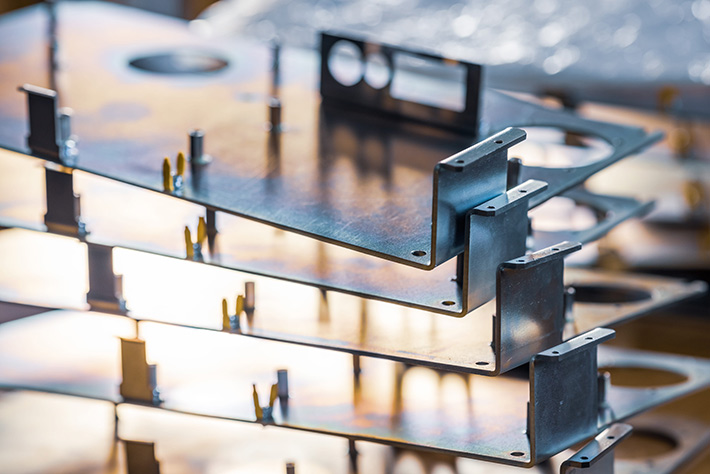
Hardware insertion is one of those steps that looks simple until they go wrong. A part comes off the laser perfectly. The bends look clean. Then the assembly starts, and someone realizes there’s no good way to bolt it together. Now you’re welding nuts, chasing threads, or redesigning a bracket you thought was done.
Clinch fasteners, often called PEM hardware, help address much of that pain.
They give you strong, repeatable threads in thin sheet metal without the mess and distortion that comes with welding.
They also help speed up metal fabrication and production by building the hardware into the part before it reaches final assembly.
What Clinch Fasteners Are and Why They Exist
A clinch fastener is a piece of hardware designed to press into sheet metal and lock in place. Instead of relying on a thick wall for threads, the fastener uses a small undercut and knurl pattern that bites into the metal when installed with the right force. Once set, it becomes part of the sheet.
This matters most in thin material. If you try to tap threads in a thin sheet, you usually end up with only one or two thread turns. That’s not much holding power. A clinch nut gives you full threads and better pull-out resistance without welding.
The Common Types You’ll See on Real Parts
You don’t need to memorize the catalog, but it helps to know the usual players.
Clinch Nuts (PEM Nuts) are the go-to when you need a threaded hole in thin material. They’re common in enclosures, brackets, and panels.
Clinch Studs provide a fixed-threaded post. These are useful when you want to hang a component on studs and then run nuts down, or when you want a clean exterior face with no bolt head.
Clinch Standoffs create spacing for boards, covers, and mounted components. If you’ve ever assembled an electrical enclosure with a control board, you’ve seen these.
There are also specialty versions for stainless steel, high-strength sheet metal, and soft materials, but the main idea stays the same: fast, strong threads without welding.
When Clinch Hardware Beats Welding Every Time
Welding nuts work. It also creates problems you might not see until later.
Weld heat can warp thin sheet, especially on panels and doors. It can burn coatings. It can leave spatter that needs cleaning.
Clinch hardware avoids all of that. You’re pressing a part in, not heating the base metal. That means:
● Less distortion
● Cleaner appearance
● Better repeatability
● Faster throughput
For high-volume work, the time savings add up quickly. For low-volume work, it’s still often the cleaner solution, because it reduces rework and keeps the part looking professional.
The Design Details That Make or Break the Result
Here’s where people get tripped up. Clinch hardware isn’t “press it anywhere, and it works.” It needs a few basics.
Material Thickness Matters
Each fastener has a minimum sheet thickness it’s designed for. Too thin and it won’t set correctly. Too thick, and you may be using the wrong style, or you may be wasting money where a tapped hole would have been fine.
Hole Size Has To Be Right
If the hole is oversized, the hardware can spin. If it’s undersize, it won’t seat, or it will distort the sheet. This is one reason clean, accurate laser cutting helps. The hardware is only as good as the hole it’s installed into.
Edge Distance Is Not Optional
Put hardware too close to an edge or bend line, and you can deform the part, crack the sheet, or weaken the clinch. If you’ve ever seen a fastener that looks “tilted” or a dimple that’s pulled toward an edge, that’s usually the cause.
Bend Clearance Needs Planning
If hardware is installed near a future bend, it can interfere with the brake tooling or create a bulge where the part needs to sit flat. This is where a quick DFM review saves a lot of pain.
The Shop Side: How It Gets Installed
Most clinch hardware is installed using a press, often a dedicated insertion press with the right tooling. The fastener is positioned, the press applies force, and the undercut locks into the sheet.
Good shops treat this like a controlled process. Wrong tooling, wrong force, or poor alignment can damage parts. When it’s done right, the hardware sits flush, doesn’t spin, and withstands torque and vibration.
If you’re building assemblies that see movement, shipping abuse, or repeated service, reliability is key.
Practical Examples Where This Pays Off
Clinch hardware is especially useful for:
● Electrical enclosures and control cabinets
● Brackets that will be removed and reinstalled for service
● Panels where the exterior face needs to stay clean
● Assemblies that need consistent torque without stripped holes
● Thin stainless parts where welding is slow and ugly
It also makes quoting easier. Instead of guessing how many welded nuts and cleanup steps a job will need, the process is more predictable.
How To Request It So You Get What You Want
If you want clinch hardware included in a fabricated part, don’t just say “add PEMs.” Provide:
● Hardware type (nut, stud, standoff)
● Thread size
● Material requirements (steel vs stainless)
● Quantity per part and total part count
● Any “cosmetic face” requirements so the shop knows which side must stay clean
If you’re not sure what type to use, a good metal fabrication partner can recommend the right hardware once they know the load, access, and assembly method.
Custom Metal Fabrication Solutions That Work
Choosing the right hardware is only part of building a reliable finished product. Working with an experienced fabrication partner helps ensure every detail supports performance, durability, and efficient assembly. Prototech Laser in Chesterfield can help you evaluate your project requirements and recommend practical solutions that fit your application. Contact our team to learn more about our custom metal fabrication and precision laser cutting services.