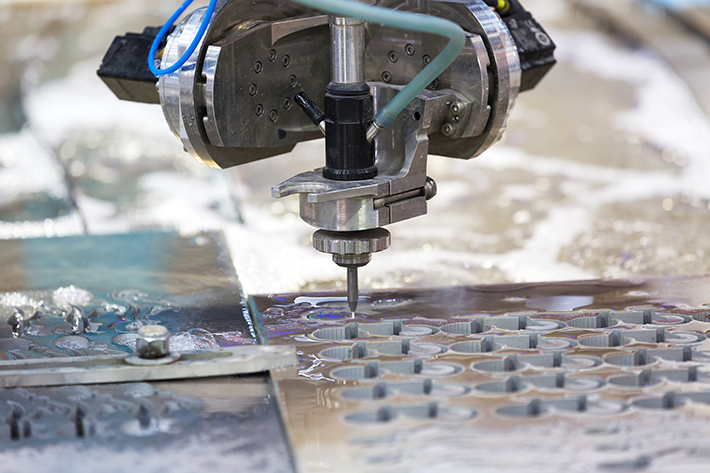
Both waterjet- and laser cutting are accurate and economical methods of producing machined parts. The differences in their processes lead to specific advantages and disadvantages. In this article, we compare and contrast the benefits and pitfalls of these two important operations.
The Pros and Cons of Waterjet
Waterjet cutting works well for smaller runs, non-metallic substrates, and for parts requiring tight tolerances.
- Waterjet Cutting Adds No Heat
As a cold process, water jet cutting offers the advantage of adding no heat during the cutting operation. Because heat can distort materials, waterjet cutting is often the choice for forming parts that demand tight tolerances.
In addition, the absence of heat-affected zones enhances operational efficiency. Cutting techniques that create heat zones result in the extra step of removing heat-impacted materials so that fabricators can move parts directly from the waterjet machines to welding. This results in saving additional costs and production time.
In addition, waterjet cutting makes such clean cuts that the need to sand and grind around part edges is eliminated. Also, efficiencies are enhanced by the automation of waterjet machines, an advantage that reduces production costs while allowing waterjet machines the flexibility to work economically for small and large runs.
- Waterjet Cutting is Not as Precise
While waterjet helps prevent material distortions, it nevertheless cuts less precisely than lasers, a disadvantage for fabricators reliant on waterjet processes alone.
For example, waterjet cutting has a minimum cut size slit of .02”, inferior to laser cutting. Also, waterjet cutting is unsuitable for thin and small parts because of the high force the process employs, which causes breakage and damage unless substrates have sufficient strength. Laser cutting is usually the best option when waterjet operations cannot produce sufficient precision.
- Waterjet Cutting Works Well on Many Materials
When it comes to working with a diverse set of materials, it’s hard to beat waterjet machines. For example, waterjet machines create precision cuts on substrates that include metal, glass, stone, ceramic, plastic, and wood. If you need to machine cut an out-of-the-ordinary material, chances are waterjet cutting is up to the job.
The Attributes of Laser Cutting
Laser cutting offers another option that works well for many jobs due to its following attributes:
- Laser Cutting Leaves Less Waste
Laser cutting offers the advantage of producing less waste material versus waterjet cutting, reducing the time and expense of waste removal. All the cleanup laser cutting requires is light vacuuming or filtering to remove dust.
In contrast, waterjet cutting results in substantial mess because abrasives mix with water. This abrasive imbued waste requires special disposal due to toxicity, a disadvantage of waterjet cutting that adds to its cost.
- Lasers Provide Speed
When you have a large volume and limited time, laser cutting provides the answer. It is one of the fastest cutting processes around. Waterjet cutting, on the other hand, takes longer, so it may not be ideal when time is tight, or you have a large run. Laser cutting works with sheet metal up to 1-in. thick. In addition, laser cutting is so highly automated that it runs unattended so that cutting can occur 24/7.
- Flexibility
Laser cutting’s efficiency is further enhanced by its ability to cut different jobs using the same tools. This flexibility reduces setup times and lends laser cutting to handling a wide variety of shapes, material thicknesses, and intricate cuts.
- Consistency
Laser cutting is a foolproof method for consistent parts production: The +/- 0.05 mm tolerance ensures each part is just like the others.
- Contactless Cutting
Contactless cutting is another reason laser cutting is highly economical, especially for large volumes. Production costs are reduced because the frictionless action of lasers allows tools to last much longer versus ones deployed in other techniques.
Disadvantages of Laser Cutting
Despite its many benefits, laser cutting does come with some disadvantages:
- Expertise Required
Not just anyone can operate a laser cutting machine. Trained operators are essential to safe and error-free cutting. Though this adds somewhat to the cost, labor is a minimal factor because so much of the process is automated.
- Metal Thickness Limitations
Very thick metal plates require a different cutting process. Metal thicknesses beyond the 20mm range are unsuitable for laser cutting and require other thermal methods.
- Upfront Costs
Though highly efficient, laser cutting machines are often twice the cost of waterjet cutters. As a result, only companies able to make a substantial upfront investment can offer laser cutting.
Two Processes Offering Great Results
Excellent results come from both laser- and waterjet cutting. The key is choosing the right method for the job. By performing a thorough project analysis, we can recommend the best process for your endeavor.
Prototech Laser has an empowered staff of project managers dedicated to exceeding your expectations in quality, continuous improvement and 100% on time delivery. With more than 30 years of experience in full-service metal fabrication, we have one of the largest industrial laser cutting capacities in the Midwest while offering beneficial solutions in metal fabrication for industries including defense, automotive and industrial sectors.
Questions? Call and speak to a specialist about your manufacturing needs today. Free Estimates